📄 New in Medical Physics (open access). Below, the short story of what we did and why it matters.
The skull is the bottleneck
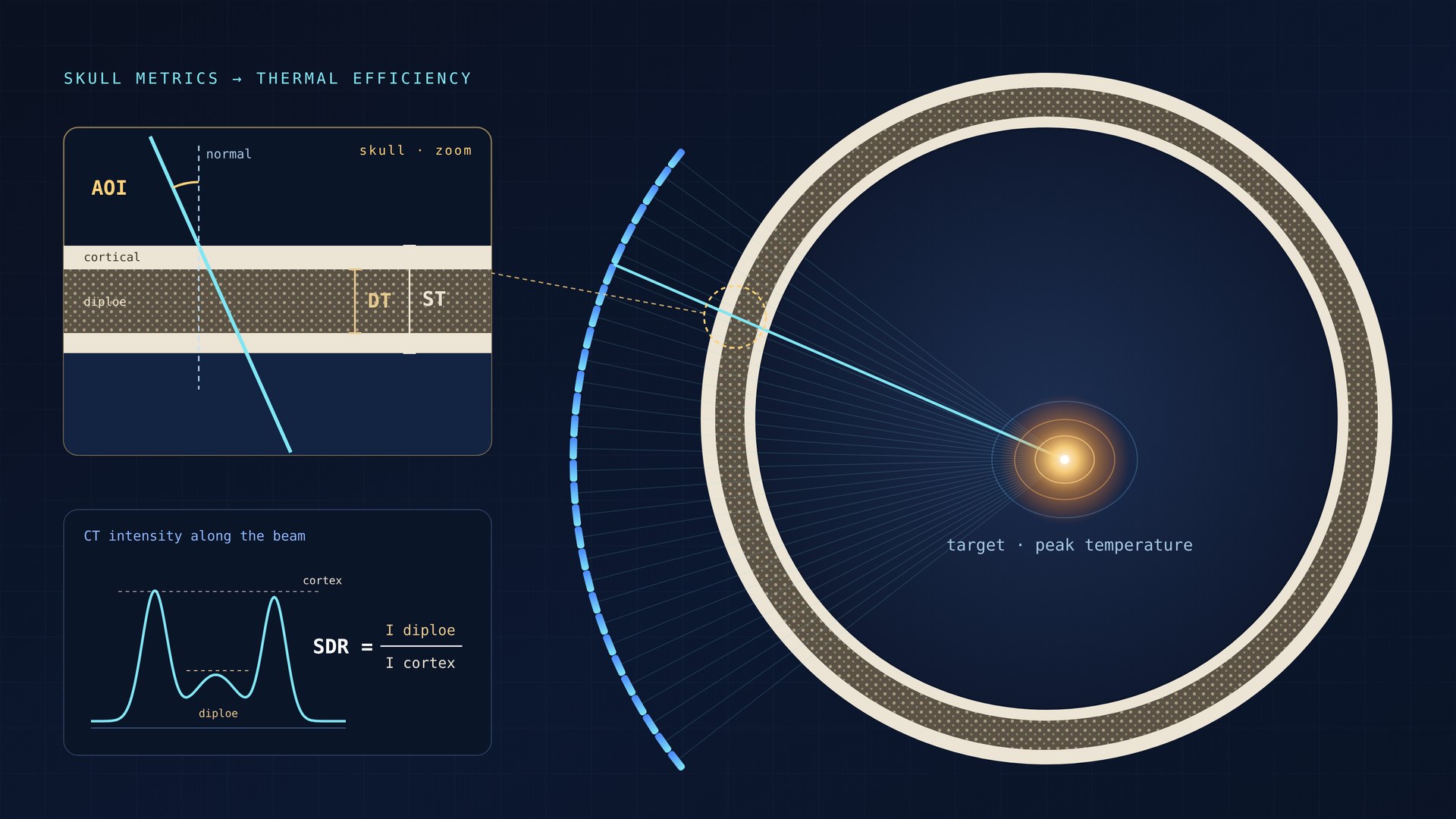
In MRgFUS, energy has to cross the skull to heat a deep target. Screening currently relies on a single number, the skull density ratio (SDR).
Patients with similar SDR can respond very differently, and energy escalation during the procedure still relies largely on experience.
What we did
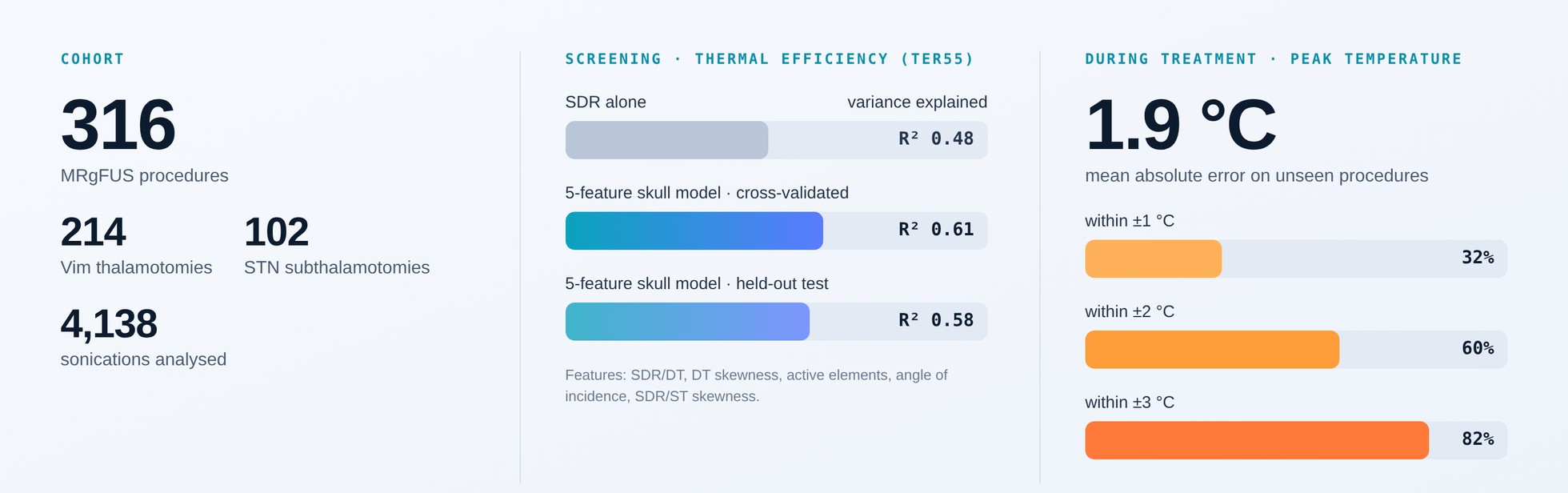
We analysed 316 procedures (4,138 sonications), extracted skull properties beam by beam, and built two models tested on unseen procedures.
What we found
SDR alone explained about half the variability; a five-feature skull model reached R² 0.61 (0.58 on an independent test set).
Subthalamotomies were less efficient than thalamotomies despite similar skulls: screening rules should not be transferred blindly between targets.
A machine-learning model predicted each sonication's peak temperature with a 1.9 °C mean error on unseen procedures.
Why it matters - and how it fits D3-HIFU
A continuous efficiency estimate instead of a yes/no cut-off, and objective choice of sonication parameters during treatment.
A first building block of the D3-HIFU decision-support platform; next, validation across the national network.
Thanks to all co-authors and to everyone who made this cohort possible.
Source: Pineda-Pardo et al., Medical Physics 53(9), 2026. doi:10.1002/mp.70652.